
By Karen Ocamb
February 9, 2015 :: 10:42 AM
LGBT people were no doubt thrilled to see young, gay British singer Sam Smith win four Grammy Awards Sunday night, publically wrapped in the loving embrace of the music world. And as the Deep South state of Alabama starts issuing marriage licenses to same sex couples on Monday, it may appear as if full equality is just inches and seconds away.
But sweet cultural appearances can be deceiving: the age-old battle between the rights of states and “the people” versus unwelcome mandates from the federal government— twisted in with the churning discomfort over changing the “traditional” definition of marriage—may be stirring up a subterranean anti-LGBT tsunami civil rights advocates have been too blinded by the prospect of full equality to see. At least that’s what two new GLAAD surveys released Monday, Feb. 9 suggest.
In “Accelerating Acceptance”—two surveys conducted by the respected Harris Poll—GLAAD indicates that there are still “substantial levels of discomfort with LGBT co-workers, family, and neighbors, despite historic legal progress for marriage equality.” One-fifth to nearly one-third of heterosexuals are “uncomfortable with common situations involving LGBT people,” says GLAAD. “These range from simple things like having an LGBT person move in next door to more personal situations such as learning that a family member is LGBT.”
And while support for marriage equality hit an all-time high of 55% in 2013 after the Supreme Court overturned the Defense of Marriage Act and Prop 8, the GLAAD surveys indicate that there is still “a significant degree of discomfort” with actual gay weddings: one-third (34%) say they would be uncomfortable attending the wedding of a same-sex couple; 22% saying they would feel very uncomfortable; and 36% say they are uncomfortable seeing gays even holding hands.
Perhaps even worse, 43% say they would be uncomfortable bringing a child to the wedding of a same-sex couple. And there’s also resistance to LGBT parents. “Many straight, non-transgender parents say they would be uncomfortable with their child playing at a home with an LGBT parent – 40% for a transgender parent, 29% for a gay dad and 28% for a lesbian mom,” the report says.
For all the apparent public acceptance of transgender actors such as Laverne Cox and other pop cultural figures like journalist Janet Mock, acceptance of the transgender community is even more difficult for straights than acceptance of the rest of the LGB community. “Most notably,” the reports says, “a majority of non-LGBT Americans (59%) say they would be uncomfortable if they learned their child was dating a transgender person. More than a quarter (31%) say this would make them “’very uncomfortable.’”
The online Harris Poll surveys were conducted among mostly heterosexuals just before and just after the mid-term elections last year. The first was conducted from August 21-25, 2014 among 2,014 adults (aged 18 and over)—of whom 1,754 indicated they are straight, cisgender (people who identify with the gender they were assigned at birth )—and November 10-12, 2014 among 2,010 U.S. adults (ages 18+)—of whom 1,821 indicated they are straight, cisgender.
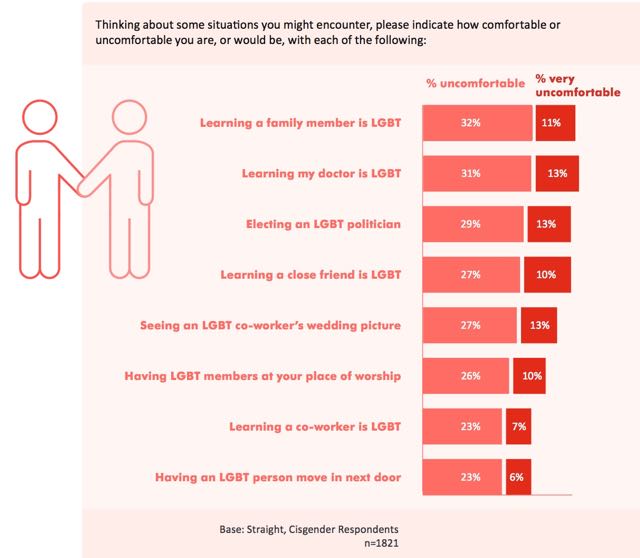
Why does this matter, especially in advance of the Supreme Court’s decision to decide the constitutional right of same sex couples to marry? Because even if the Court rules in favor of marriage equality, having the Court—or Congress or a state legislature—recognize a constitutional right doesn’t mean that civil right is cemented in concrete or will be actually enforced or can’t be dodged, undermined or other wise overturned or taken away.
For instance, the Supreme Court ruled in Roe v. Wade that a woman has the constitutional right to determine her own reproductive health. But in reality, over the last four years, states have enacted 231 abortion restrictions making access to abortion and reproductive health prevention and treatment nearly impossible for low income women in many states.
And, it is critical to remember that the day before the Supreme Court overturned DOMA and Prop 8, it invalidated Sec. 4 of the 50-year old Voting Rights Act, thus enabling states and counties to create barriers to voting, disenfranchising people of color in particular. Securing the fundamental right to vote for African Americans was what the Freedom Rides and bloody marches from Selma to Montgomery where all about.
Having support from the courts and the federal government is one thing—but real progress relies on the acceptance of the majority. LGBT Californians know this all too well: after the California Supreme ruled in In Re Marriages that same sex couples had the right to marry, the same court ruled that “the people” had a right to take away that right away through the infamous state initiative Prop 8. While the No on Prop 8 campaign was cognizant of the “moveable middle” during the fight over Prop 8 in 2008, the campaign failed to consider just how “moveable” supporters such as women actually were and thus failed to deeply secure that vote long before election day. The recent report by the LA LGBT Center on how to persuade and keep voters is a critical companion to the GLAAD surveys.
As the country becomes more and more deeply politically divided, the America ideal of protecting the rights of minorities seems to have become increasingly subservient to the rights of the majority of “the people.” Therefore, whether LGBT advocates like it or not, winning the hearts and minds of straight people is key to getting and keeping LGBT civil rights.
“Closing the gap to full acceptance of LGBT people will not come from legislation or judicial decisions alone, but from a deeper understanding and empathy from Americans themselves,” said Sarah Kate Ellis, the CEO and President of GLAAD in a press release. “Accelerating acceptance will require the help of not just LGBT people, but also their allies – everyday Americans who feel strongly and take an active role to make sure that their LGBT friends and family are fully accepted members of society.”
Interestingly, the GLAAD surveys come out at the same time as a new study from the Family Acceptance Project indicates that, despite the prospect of victimization, LGBT youth who come out at school wind up with a greater “positive adjustment” as young adults and have “significantly lower levels of depression with higher levels of self-esteem and life satisfaction,” according to a press release, compared with LGBT youth who did not come out or who concealed their sexual orientation or gender identity at school.
“Until now, a key question about balancing the need to protect LGBT youth from harm while promoting their well-being has not been addressed: Do the benefits of coming out at school outweigh the increased risk of victimization? Our study points to the positive role of coming out for youth and young adult wellbeing” said lead author, Stephen T. Russell, Ph.D., Distinguished Professor, University of Arizona.
“This study has important implications for how adults and caregivers support LGBT youth,” said Caitlin Ryan, Ph.D., Director of the Family Acceptance Project at San Francisco State University and study co-author. “We know from our other studies that requiring LGBT adolescents to keep their LGBT identities secret or not to talk about them is associated with depression, suicidal behavior, illegal drug use and risk for HIV. And helping them learn about and disclose their LGBT identity to others helps protect against risk and helps promote self-esteem and overall health. This study underscores the critical role of school environment in influencing LGBT student’s risk and well-being into young adulthood.”
Put into a political context, these surveys underscore the importance of monitoring and countering anti-LGBT campaign rhetoric building up to the 2016 elections.