By Karen Ocamb
February 18, 2015 :: 10:44 AM
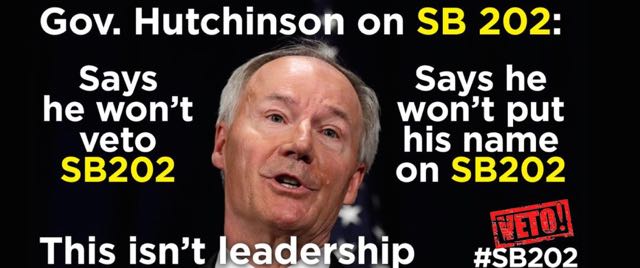
Gov. Asa Hutchinson is set to let Senate Bill 202 (SB 202) become law any day now without his signature. The bill, known as the Intrastate Commerce Improvement Act, claims to standardize civil rights laws throughout the state by banning cities and counties from adopting anti-discrimination ordinances for classifications of people not already listed for protection under state law. And that would be LGBT people, who would be prohibited from advancing LGBT equality legislatively and would have existing civil rights stripped in the two municipalities (Little Rock and Eureka Springs) with pro-LGBT protections in employment, housing, and public accommodations.
“The Governor has the power to tell the nation that Arkansas welcomes all people, regardless of sexual orientation or gender identity, “said Human Rights Campaign Arkansas State Director Kendra R. Johnson. “Senate Bill 202 destroys local control and denies municipal governments the ability to pass civil rights protections for people in their cities.”
HRC President Chad Griffin, an Arkansas native who often talks about being a lonely gay boy in his hometown of Hope, has not yet commented.
Arkansas knows something about the struggle over civil rights. It was the first state to test desegregation after the 1957 Supreme Court ruling in Brown v Board of Education that “separate but equal was unconstitutional.” Then-Gov. Orval E. Faubus didn’t stand in the doorway of the Little Rock Central High School to prevent nine African American teenagers from entering like Gov. George Wallace did in Alabama—but he mobilized the National Guard and allowed white mobs to keep the kids out until President Eisenhower intervened.
Oddly, neither former President Bill Clinton— also the former governor of Arkansas who famously called himself “the man from Hope” during his presidential campaign in 1991—nor former First Lady Hillary Clinton have made statements about the bill, though they were asked by the Washington Blade via the Clinton Foundation . Perhaps the Clintons have forgotten how the Los Angeles-based LGBT political group ANGLE (Access Now for Gay & Lesbian Equality), lead by “friend-of-Bill” David Mixner, raise $3.2 million in early money for the then-long winded dark horse candidate. Who needs to remember how they got to where they are now—it was so long ago.
But surely Hillary Clinton will understand how the LGBT community might scratch its collective head in wonder that in 2011 as Sec. of State she could deliver such an extraordinary message of support for LGBT people internationally—“gay rights are human rights”—but fail to stand up for LGBT people in her former home state. What does that portend for LGBT support for her presumed 2016 run for president—surely she remembers the false hope of “inevitability.”
But as frightening as is the prospect of having LGBT civil rights prohibited or stripped away in Arkansas, even more worrisome is the right-wing-fingers-crossed hope that the bill and Hutchinson’s tactic of inaction will become a model for other conservative Republican-run states that don’t recognize LGBT equality.
Unlike Arizona’s SB 1062—the bill vetoed by conservative Republican Arizona Gov. Jan Brewer after an avalanche of business, political and religious leaders opposed it—and unlike the very similar 1992 anti-gay voter-passed Colorado initiative Amendment 2, which was overturned by the Supreme Court in Romer v Evans—SB 202 does not explicitly name LGBT people for exclusion. And therein lies a major problem in challenging the law in court, if it becomes law.
“It would depend in large part on whether a court would see beyond the wording of the law to the discriminatory reason why it was adopted and the intentional harms it would inflict upon LGBT people and other minority group members,” Jon Davidson, legal director at Lambda Legal, told The Blade’s Chris Johnson. “When it can be shown that a law was passed in order to facilitate discrimination, that should create a presumption that it’s unconstitutional.”
The Blade notes that the National Center for Lesbian Rights already lost in court when challenging a 2011 similar law in Tennessee that also “prohibits municipalities from enacting non-discrimination ordinances of classes of people not recognized in state code.”
The political tug-of-war over SB 202—as well as other bills focused on personal “religious liberties” versus secular state and local civil rights laws—could also become a model in the resurgence of the historic fight between states rights and federalism, exemplified by the civil war between the confederacy and the union. Sometimes it feels that a new war of the confederacy is underway, just marketed differently.
LGBT activists are hoping businesses such as the Arkansas mega-giant Walmart, which has a company non-discrimination policy, will step up and pressure Hutchinson to veto the bill. But so far, crickets.
Activist Scott Wooledge has created a website to keep track of what’s happening in Arkansas: VetoSB202.