
Practically sprung from a Silver Lake wet dream, the eponymous figure in Ray Bradbury’s short story collection The Illustrated Man is covered from neck to waist in hyperrealistic tattoos. In the words of the author, “He was a riot of rockets and fountains and people, in such intricate detail and color that you could hear the voices murmuring small and muted, from the crowds that inhabited his body. When his flesh twitched, the tiny mouths flickered, the tiny green-and-gold eyes winked, the tiny pink hands gestured.”
Over the course of the book, the images spring to life, vividly detailing each sci-fi fable. By creating this living tapestry of ink, Bradbury not only constructs a creative frame to unite his disparate tales but evokes a cultural tradition tracing its roots to another human condition—homosexuality.
Since the dawn of civilization, gay culture and tattoo culture have shared a twin history. Native Americans, who often venerated their gay tribesmen as spiritually superior shamans, used tattoos as a rite of passage and as part of religious ceremonies. Japanese samurais, a warrior class who practiced the same-sex tradition of wakashudo (an eastern analogue of Greek pederasty), were also responsible for reviving the art of tattooing within their culture.
Of course, both tattooing and homosexuality were often victims of negative perception through various eras. The Roman Empire devolved pedantic tradition into a socially imbalanced act between noble tops and their indentured bottoms, while tattoos were a deformity forced upon criminals and slaves. In Nazi concentration camps, Jews, Gypsies and homosexuals were branded like cattle. After WWII in the United States, tattoos were restricted to sailors and criminals, while pre-Stonewall gay culture lurked in the shadows of speakeasies and metaphorical closets.
Over the last several decades, though, both gays and tattoos have stepped into the spotlight. First they gained a foothold as counter-cultural elements, but more recently they’re managed to nestle into the mainstream. According to Noah Michelson, Executive Editor of The Huffington Post Gay Voices, this normalization is a direct result of visibility.
“I think as we evolve as a culture in general, we become more permissive in terms of how we include and understand people who we may have shunned,” says Michelson. “I think that includes queer people and tattooed people. The more we see them, the less strange it gets to be.”
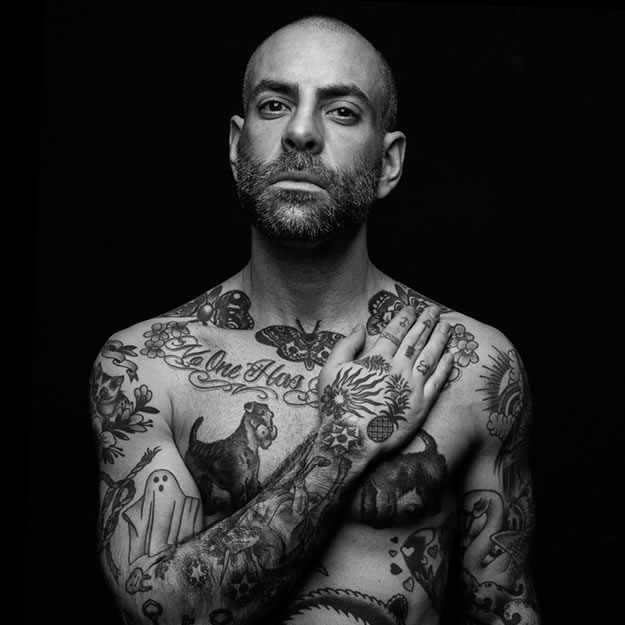
Michelson speaks from firsthand experience, both as a queer man and as a tattooed man. An illustrated man himself, Michelson is inked on nearly every inch of his chest, arms, back and stomach. He has just recently begun tattooing his legs as well, the ultimate goal being to ink his entire body—almost. “Not above my neck,” Michelson says, “and I won’t get my junk tattooed, either.”
While ancient warriors tattooed themselves out of honor and tribal identity, Michelson represents a contemporary subculture of gay men who ink themselves as an act of rebellion and self-expression.
“I’ve always wanted to be tattooed,” he says. “My parents were very much against it. When I was 32, five years ago, I decided it was time. I didn’t realize why until a couple years ago. All my tattoos have a meaning behind them. I felt, as a queer person, I had so many stories inside of me that for so much of my life I was ashamed of. To be able to take emblems of those things and put them on my body, where they were visible to the outside world, it was almost like bloodletting in a way. It was a way of getting things off my chest by putting things on my chest.”
Like Bradbury’s titular figure, each of Michelson’s tattoos tell a different story. The image of Jesus on his bicep is a nod to his school-boy crush on the son of God. A pair of Airedale Terriers on his pecs represent his childhood pets Sadie and Daisy. The cartoonish ghost on his left arm captures the goofy personality of his father, whom he lost to cancer eight years ago.
Michelson’s most powerful tattoo is arguably the Tom of Finland figure on his forearm. “For me, it was a commitment to never going back into the closet,” he says, a simple statement illustrating the true power of meaningful ink.