
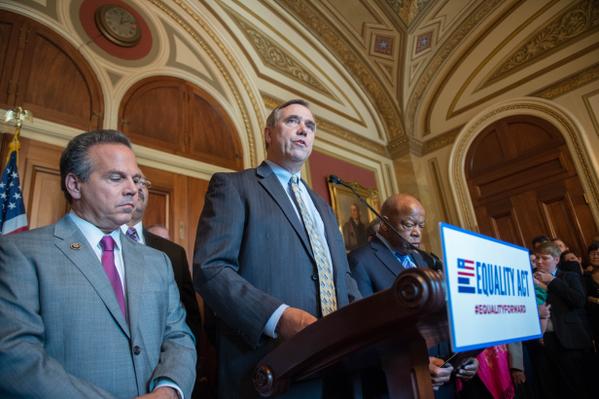
Congressional Democrats introduced the Equality Act on Thursday to much fanfare on Twitter but little attention elsewhere as the Senate Foreign Relations Committee grilled Sec. of State John Kerry about the Iran nuclear weapons deal and Republican presidential frontrunner Donald Trump landed in Laredo, Texas to scrutinize “the massive problem” of illegal immigration on the U.S.-Mexico border. Though the bill has been introduced in the anti-LGBT Republican-controlled least productive Congress in history, nonetheless, the Equality Act provides a tremendous political opportunity to get electoral candidates on the record: do you support equality for or discrimination against LGBT people?
The Equality Act is not a stand-alone bill but would rather amend existing laws such as the Civil Rights Act of 1964 to close discrimination gaps, which has displeased some LGBT advocates. As trans activist Mara Keisling, executive director of the National Center for Transgender Equality, noted in her op-ed on the Frontiers blog Wednesday, the Equality Act is the “LGBT rights bill we want and need,” going beyond the previous Employment Non-Discrimination Act. The federal legislation protects LGBT people, especially in states with no non-discrimination policies, and prohibits discrimination against LGBT people in education, employment, federal funding, housing, credit, and jury service.
Senate Equality Act co-sponsor Jeff Merkley said (at the podium with David Cililline and John Lewis, above):
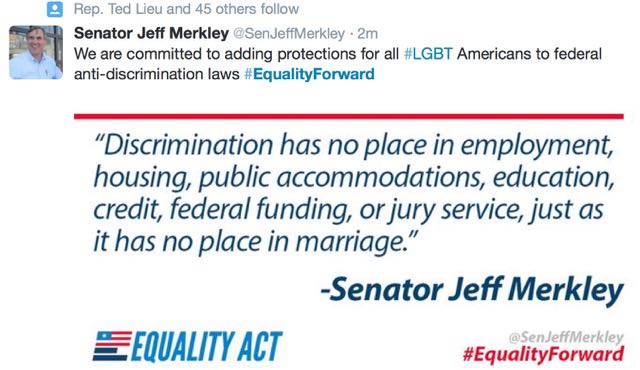
Out Rep. David Cicilline said:
Additionally, as Keisling noted, “the bill will also codify the existing interpretations of sexual orientation and gender identity bias as being forms of sex discrimination, which many courts and federal agencies including the Equal Employment Opportunity Commission have already embraced.”
But of particular importance to Californians facing the prospect of a possible anti-trans “bathroom bill” initiative on the 2016 ballot, the Equality Act would mandate that schools allow trans students to use locker rooms and bathrooms that reflects their gender identity. A fact sheet for the bill says: “Where sex-segregated facilities exist, individuals must be admitted in accordance with their gender identity.” Additionally, the bill’s language suggests trans prisoners would also be protected and housed according to their gender identity.
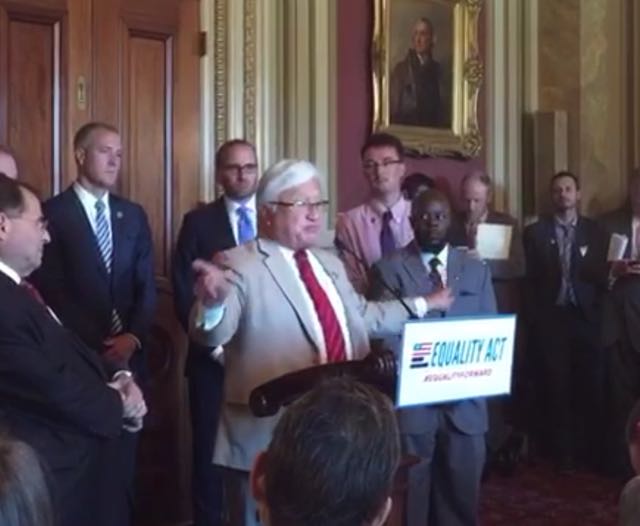
Rep. Mike Honda, who has a trans granddaughter, underscored the trans inclusion saying “we cannot forget gender identity – the #EqualityAct will protect #trans people.”
The Human Rights Campaign also launched a major push on the bill, including creating the new hashtag #EqualityForward.
“The time has come for full federal equality — nothing more, nothing less,” said HRC President Chad Griffin. “While America is now a marriage equality nation, the tragic reality is that millions of LGBT Americans face persistent discrimination in their lives each and every day. In most states in this country, a couple who gets married at 10 AM is at risk of being fired from their jobs by noon and evicted from their home by 2 PM, simply for posting their wedding photos online. Congress must pass the Equality Act to ensure that LGBT people and their families are just as safe at work or at school as they are in their marriages. This bill will guarantee all LGBT Americans have the clear, permanent, and explicit protections from discrimination that they deserve.”
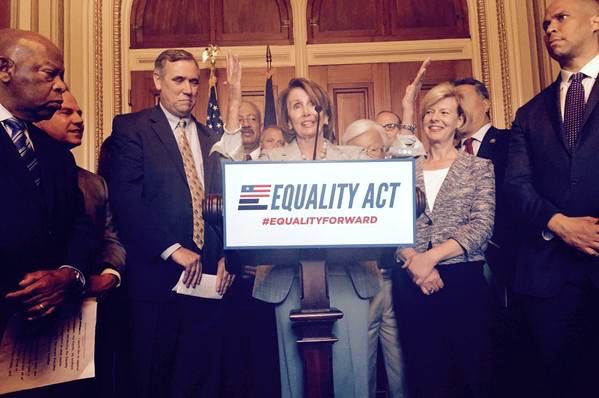
The Equality Act was introduced by Senators Jeff Merkley, Tammy Baldwin, Cory Booker, and out Rep. David Cicilline and has more than 140 cosponsors in the House, including Rep. John Lewis and Minority Leader Nancy Pelosi and at least 39 in the Senate.
Los Angeles Democrat Rep. Ted W. Lieu was among the straight allies who issued statements of support:
“As a Vice Chair of the LGBT Equality Caucus, I am proud to stand with Congressman Cicilline and the rest of the Caucus to support the Equality Act. This landmark piece of legislation will eliminate gaps in federal law that currently allow discrimination and harassment based on sexual orientation and gender identity. Although the Supreme Court’s decision last month in Obergefell v. Hodges was a huge victory for LGBT rights, there is much work left to be done. The discriminatory reactions to the legalization of marriage equality nationwide have demonstrated the urgent need for comprehensive legislation to prevent discrimination against the LGBT community. I look forward to working with my colleagues in Congress to pass the Equality Act to ensure that all Americans are protected under the law and cherished under a fundamental principle: love is love.”
Before the Act was introduced, HRC released new polling that shows support for federal non-discrimination protections exceeds even marriage equality:
Likely voters support workplace non-discrimination protections by a massive 78 percent to 16 percent margin. This includes support from 90 percent of likely Democratic voters, nearly two-thirds (64 percent) of likely Republican voters, and 70 percent of observant Christians.
Moreover, nearly 60 percent of voters are less likely to support a candidate who doesn’t support such protections for LGBT people, including 61 percent of Independent voters and 58 percent of Catholic voters.
“Everyone should have a fair chance to earn a living, provide for their families, and live their lives without fear of discrimination,” Griffin added. “This polling makes crystal clear that the American people agree, and that many are willing to vote opponents of equality out of office because fairness and equality for all is so important.”
HRC also launched a #31Reasons social media campaign to share stories of discrimination from across the country and highlight the fact that 31 states lack explicit, fully-inclusive non-discrimination protections based on sexual orientation and gender identity.
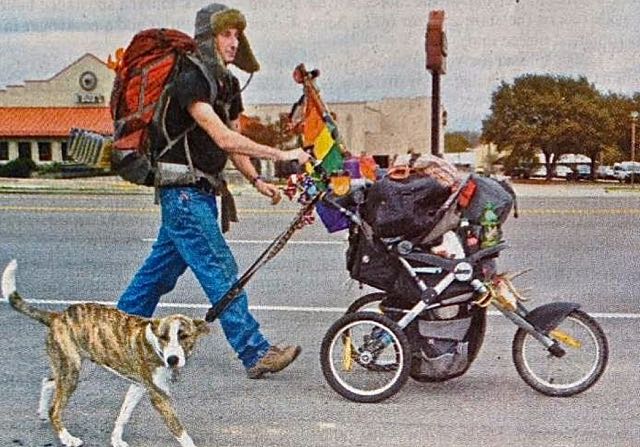
One person not on any podium or cited in the multitude of press releases about the Equality Act was Richard Noble, formerly of West Hollywood, who now lives in Palm Springs. During 2011-2012, Noble took on the spirit of Harvey Milk and walked across the country with the Rainbow flag to “recruit” Americans on behalf of what was then called the American Equality Bill Project. For 15 grueling months, Noble talked to people he met about the bully and suicides of LGBT teens was part of a larger system problem caused by lack of comprehensive civil rights protections for LGBT people. Noble said in an email:
I was approached by attorney Todd (Tif) Fernandez and was convinced of the call and need for an American Equality Bill. At first not very many people understood the civil rights language. It was a daunting task to educate the American people but on this day of the announcements by our friends in Congress of the joint filing of OUR LGBT civil rights act, I broke down. I cried, I inwardly cheered and thought about all the states these feet marched along with the Rainbow flag for 2700 miles or if counting, about 5 Million 400,000 steps…..
So, this was your walk. This was our walk. This was a long walk and I am tired. Let’s pass The Equality Act once and for all.
The Equality Act would protect 9.5 million LGBT adults, according to Gary Gates, Williams Institute Blachford-Cooper Distinguished Scholar and Research Director. The Williams Institute noted – with statistical information that could be useful during the 20-15-2016 campaign season:
- In response to a national survey conducted in 2013, 21 percent of LGBT people said they had been treated unfairly by an employer because of their sexual orientation or gender identity.
- In a national survey conducted in 2008, 42 percent of LGB respondents reported experiencing employment discrimination because of their sexual orientation or gender identity at some point in their lives, and 27 percent had experienced discrimination in the five-year period prior to the survey. The survey also found that one-third of LGB employees are not open about their sexual orientation at work.
- In response to the 2010 National Transgender Discrimination Survey, 78 percent of respondents reported experiencing harassment or mistreatment at work because of their gender identity.
- In six other surveys conducted in the past 10 years, 19 percent to 44 percent of LGBT people reported experiencing discrimination or harassment based on their sexual orientation or gender identity at work.
Non-LGBT people also report witnessing discrimination against LGBT people.
- Across a number of studies, 12 percent to 30 percent of non-LGBT respondents reported witnessing such discrimination.
- About 83% of American adults report in recent polls that LGBT people face moderate to high levels of discrimination.
Research indicates that gay men and transgender people earn less than their non-LGBT counterparts.
- Gay men earn 10 percent to 32 percent less than heterosexual men who have the same productive characteristics, such as experience and level of education, according to 12 studies.
- Transgender people are unemployed at twice the rate of the general population, and 15 percent have reported incomes of less than $10,000 per year, according to the National Transgender Discrimination Survey.
LGBT people use non-discrimination laws at comparable rates to women and people of color.
- LGBT employees file administrative complaints of sexual orientation discrimination at a rate comparable to filings of sex discrimination by female employees and complaints of race discrimination by employees who are people of color, according to two Williams Institute studies.
Reducing discrimination and improving workplace climates for LGBT employees can be good for business.
- Research has demonstrated that LGBT-supportive policies and workplace climates are linked to greater job commitment, improved workplace relationships, increased job satisfaction and improved health outcomes in LGBT employees.
The bill may be championed by a slew of LGBT advocates on both sides of the partisan aisle but in reality, in this religious conservative-run Congress, the Equality Act is not expected to succeed in Congress. Meanwhile, Congressional Republicans are pushing the First Amendment Defense Act that would allow businesses and individuals to act on the basis of their religious beliefs without federal intervention. This Act, introduced by Sen. Mike Lee of Utah and Rep. Raul Labrador of Idaho, has 134 co-sponsors in the House and 36 co-sponsors in the Senate.
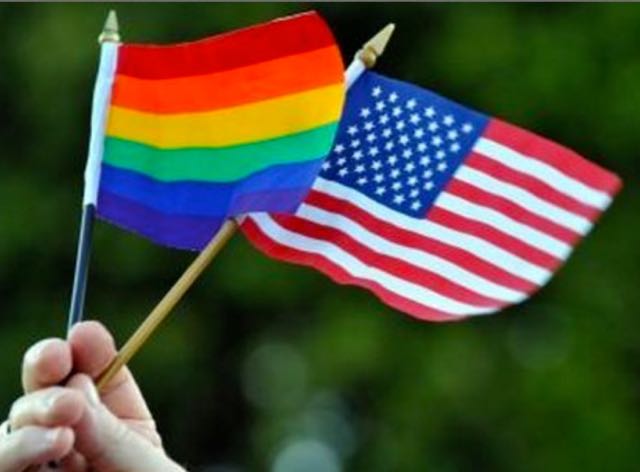
It will be interesting to see how these bills play out in the political season and on the campaign trail. Will Republican House Speaker John Boehner even allow the Equality Act to come up for a vote?
The introduction of the Equality Act should be considered a gauntlet thrown down by the LGBT community to elected officials seeking re-election and those campaigning to replace them: pledge your support for the Equality Act or your name will be recorded on the wrong side of history.