
By Karen Ocamb
September 13, 2015 :: 2:54 PM
Los Angeles-based trans Latina activist Bamby Salcedo and #TransLivesMatter activists received an unusual reception when they stormed the stage at the U.S. Conference on AIDS in Washington, DC on Friday, Sept. 11. Unlike their surprise action at Netroots Nation last February, they were welcomed by Paul Kawata, Executive of the National Minority AIDS Council, which hosted the event, and were allowed to speak for about 20 minutes during the lunchtime plenary session.
“That was one of the great things about it,” Salcedo said in a phone interview Sunday. “[Paul Kawata] actually came up to me when we were gathering in the lobby and said, ‘I know you’re doing this. How can I help?’ I said, ‘Give me the mic.’ It was very different from Creating Change. The first thing they did when we stormed the stage was turn off the lights. They wanted us to leave. When we didn’t leave, they finally turned the lights on and gave us the mic. This time, they gave us the mic right away. We said what we wanted to say and I read our list of demands—and he (Kawata) was very supportive. It felt like we were not being banned from this space.”
Afterwards, HIV Plus Magazine reports, the “activists were applauded by the audience.”
As they did at Netroots Nation, the activists called for justice instead of lip service, chided “the non-profit industrial complex” for “making money on the backs of trans women of color” but not employing them, and called out national institutions for failing to include or properly represent trans women and men in data collection that leads to public policy—all of which can lead to violence.
One national institution Salcedo, TransLivesMatter and their allies called out at the AIDS Conference was the Office of National AIDS Policy.
Salcedo, who is “unapologetically” HIV positive, started her activism working with the L.A.-based Latino AIDS group Bienestar and their program Transgeneros Unidas, after which she worked at the transgender program at L.A. Children’s Hospital. As founder of the Trans-Latin@ Coalition, she spoke at the historic trans women of color briefing at the White House last March and has lead numerous demonstrations and protests in Los Angeles and Long Beach over the epidemic of murders of trans women. Salcedo is the subject of the documentary “Transvisible: The Bamby Salcedo Story.” In other words, there is much substance and experience behind her screams.
“It’s terrible,” Salcedo said about the launch of ONAP’s new HIV/AIDS Strategy, about which everyone is “making a big deal as 2.0 this and that.” While the previous plan at least mentioned trans people, she said, “they didn’t implement what they said they were going to do.”
The new 2.0 strategy “just barely mentioned” trans inclusion, Salcedo said, noting that ONAP conducted numerous regional meetings, including one in L.A., “and they didn’t include what the community said needed to be in it. That means they’re not actually listening to the community.”
Salcedo said she didn’t register—the AIDS Conference is “too expensive” for many HIV-positive grassroots activists—and crashed the event specifically to protest at the “Mind the Gap: From Vision to Reality” lunch plenary where she knew ONAP and representatives from different federal agencies would be in the audience.
“It is very important that you secretly mobilize people as we don’t want to alert conference organizers about the interruption and what we are doing. Please invite as many people as you can to the event, it does not matter if people are not register as we are all going to storm in without asking permission,”Salcedo wrote in am email to TransLivesMatter activists beforehand.
“It’s kind of the same thing like Creating Change,” Salcedo said on the phone Sunday said. “We wanted to create awareness” that the messages that these institutions are sending is that “trans people are not important,” messages that “ultimately are getting trans people killed.”
The activists called for ONAP “to invest in trans people and don’t think trans lives are disposable and don’t matter and to actually implement what the community asked for. That’s not just forming a group to give advice but to do implementation. They can’t just ignore what people are saying. They have to look at the big picture where trans people continue to be marginalized.”
Salcedo said the trans protesters were joined by gender non-conforming activists and some ally members of a network of HIV positive women, who approached them in the lobby.
“We are not gay men,” the activists chanted on stage.
Salcedo said trans activists submitted a proposal to the CDC 10 years ago advocating that trans women be separated from risk category of MSM (men who have sex with men) for the institution’s data collection. “They must start implementing new data collection systems—not just the CDC but all federal systems,” Salcedo said. “There should actually be two tiers to their recording process. But that can only happen if it’s mandated by the Office of National AIDS policy.”
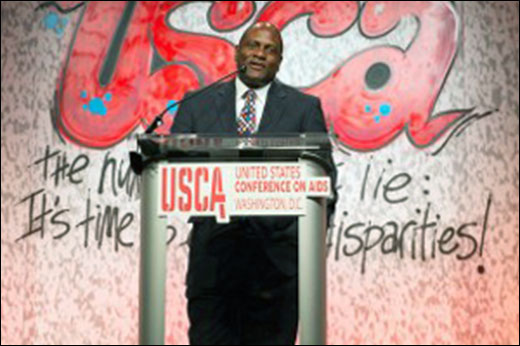
Salcedo said she has not yet met with the new ONAP director, Douglas Brook (pictured above) in DC. But she wants to “have a conversation” with him about “how to move forward and how to implement their demands,” she said. “Actions speak louder than words.”
Interestingly, last June, many surviving members of ACT UP gathered for a reunion in San Francisco to commemorate the 25th anniversary of the disruption of the 6th International AIDS Conference in 1990. Inside the Moscone Center, ACT UP disrupted and shouted down U.S. Health & Human Services Sec. Louis Sullivan with “Shame! Shame! Shame!” and a banner saying ‘No More Words, We Want Action.” This year, it was Bamby Salcedo yelling form the stage: “we know what needs to be done in order to eradicate this epidemic in our community.” And, as ACT UP member Peter Staley noted in a tweet from the conference, Salcedo and the activists called for action with “ACT UP! FIGHT BACK!”
Here are the statement and demands Salcedo read from the stage:
“Mind the Gap”– Trans People State of Emergency & Demands to the Office of National AIDS Policy
Purpose: To bring attention to the continuous structural violence that has been created by the Federal Government over the years against Trans people in the field of HIV. To address the lack of funding to Trans led programs and organizations and to bring attention the gap in support and services that need to be address in order to better the quality of life of Trans people in the United States around HIV prevention and care.
- Statement: Trans people has been marginalized over the years in the field of HIV. Even though there has always been advocacy brought to the table by strong Trans individuals and leaders, our pleas, comments and suggestions have been ignored throughout the years. Even when there was data to prove the infection rates in Trans people, Trans people continued to be lumped with other populations demonstrating by policy makers, funders, and leaders in the HIV field that the lives of Trans people were disposable. Actions have spoken louder than words and we are tired that you don’t listen to our needs and to our voices. Our community continues to be left behind, ignored and not taken serious. Today is a different day! We are here to demand to all of the influential people in the room that the lives of Trans people are valuable and you need to take us seriously. You cannot play with our lives any more, we are here to demand justice for Trans people around HIV and we are here to demand that you do the humane thing and not continue to put excuses anymore and do what needs to be done to address the HIV epidemic in our community. The time is now, and if you are truly sincere about meeting the gap, then you need to start by closing the gap that you have created from the beginning. It is time to close the gap and know that our lives are in your hands and it is your responsibility to leverage your power to improve the quality of life of Trans people by looking at the bigger picture and address social determinants and how those affect our lives. You must intentionally invest in the improvement of the quality of life of Trans people by meaningfully allocate equity of resources in order to eradicate the HIV and health crisis that our community faces. You must show that as a government agencies you going to do what is the humane thing to do and will close the gap around the institutional violence that continues to destroy our community.
Our demands are as follow:
- We demand that ONAP issues strong guidelines for the implementation of transgender-inclusive data surveillance with Health and Human Services Department (HHS) and across all Federal Agencies and not only the Centers for Disease Control and Prevention (CDC). We applaud CDC for revising the EHARS system for reporting HIV cases that includes a two-step data collection method that allows for current gender identity and follows up with the sex assigned at birth. It is essential that this shift in surveillance policy be implemented to collect very much needed data that reflects the epidemic in the Trans community across all Federal agencies through HHS. This effort must be mandated to be implemented in all state and territorial public health agencies who receive funding from the Federal Government in order to support the reporting of fully inclusive epidemiological data that reflects the reality of the HIV epidemic in the Trans community.
- We demand that ONAP holds consultations with transgender people living with or at risk for HIV, for ONAP to actively listen and understand the needs of the Trans community across the country and to develop a comprehensive and specific strategy that will address the needs of the Trans community around HIV prevention and care.
- We demand that ONAP intentionally invest, strengthens and sustains the model of community dialogue by engaging in specific outreach to transgender communities, especially transgender communities of color, and other key populations, including individuals engaged in commercial sex, young people, disabled.
- We demand that ONAP makes strong recommendations and mandates funding allocation to prevention and treatment interventions, programs and organizations that are designed and focused specifically on Transgender populations and that are led by Transgender people. We know that Peer and community-led programs that focus specifically on Transgender people and have transgender people in leadership positions, delivers trust among program participants and cultivates professional growth among our community. Therefore, this model ensures the professional development of the Transgender community which supports our empowerment.
- We demand that ONAP develops a comprehensive research agenda that will address the specific needs of the Trans community. Our people are dying and it is your responsibility to ensure that there is data that supports the needs of Trans people around HIV and care. This research agenda should include Trans people who are most impacted by the disease including gay and bisexual transgender men. Data collection and research on Trans people have been overlooked for years and it is the responsibility of our government to take care of all people, this includes Trans people.
- We demand that ONAP works with The Department of Justice to stop the criminalization of Trans people and review and reform HIV criminalization laws and practices related to commercial sex to ensure they are consistent with public health strategies. We engage in the sex industry because the system is design for us not to be validated as people. We are not able to protect ourselves if there are laws that convict us if we have condoms in our possession and are used as evidence to convict us. These are marginalizing strategies that must come down, and we are holding you accountable as a government agency to ensure that you protect the lives of Trans people and not criminalize us simply for who we are.