
By Drew Mackie
October 5, 2015 :: 8:30 AM
On a sunny Saturday in September, 60 people have gathered in UCLA’s Biomedical Sciences building. They’re in a room that sits on the same floor as the university’s AIDS Research Center, but attendees have not arrived to pursue science. Science-fiction? Maybe.
They’re all participating in a meet-up of Gay Board Gaymers, a Glendale-based group that boasts more than 1,100 members and meets about every two weeks throughout the greater Los Angeles area so attendees can roll dice, socialize and learn new rules in the name of fun. I’m sitting at a table next to Matthew Michael Brown, known for winning the second season of the Playstation reality show The Tester, where he proudly bore the nickname “Gaymer.” Today he’s active in Los Angeles’ gay board gaming subculture.
The group has decided on Dark Moon, a new release that began as a fan-made Battlestar Galactica game. Brown and six others are midway through the game, and while those Dark Moon-ing for the first time seem comfortable with the concept, the conversation frequently breaks into discussions about the rules, with players on opposing sides helping each other understand the modus operandi. The game, after all, is only fun if everyone understands what’s happening, and everyone seems happier to create a sense of camaraderie than simply to crush their opponents into space dust.
After about 30 minutes of play, one of the players imitates Heidi Klum’s Project Runway catchphrase—“You’re either in or you’re out.” It’s the gayest thing that’s happened during this game. And that might seem counterintuitive, considering that Gay Board Gaymers has the word “gay” in its name twice.
Brown explains that LGBT-focused gaming groups aren’t all that different from their ostensibly hetero counterparts. “In fact all LGBT gaming groups I know are filled with straight attendees,” he says. “Sexuality isn’t a big deal. It’s just an added thing everyone can connect on, and I think people subconsciously like knowing there’s always dating potential within the group.”
Monica Yencer is the organizer of Gay Board Gaymers, established in 2009. She credits the group’s success to how welcoming its members are. “Oftentimes queer people aren’t as close with their families, and that leads us to create our own families,” she says. “We feel at home and can be ourselves around people who won’t judge us because they are just like us. And if that isn’t family, I’m not sure what is.”
As it stands now, about one in five of the gamers is female, but Yencer pledges that she’s working to even out the ranks. For her, it’s important that groups like hers exist so queer people can spend time around each other outside of the bar scene. “This is a way to be around our community while participating in a hobby we all love,” she says.
Back at the Dark Moon table, the group is attempting to suss out which of the players is evil. If anyone should be well-suited to pick out who’s hiding a secret based on behavioral cues, it should be a bunch of gay guys. In the end, however, the covert bad guys win. Again, the outcome doesn’t seem to matter as much as the group deciding whether this new game was worth playing.
Brown, who also hosts events with a smaller, private group he calls Tabletops and Bottoms, conjectures that gay people might be more willing to participate in an activity some would dismiss as “nerd stuff” because they’ve likely grown up with pejorative labels.
“We might be better equipped to embrace the labels one gets for playing these types of games. Growing up as a ‘faggot’ makes ‘nerd’ a title of honor by comparison,” he says. “Gaming also lets us return to the fantasy worlds of our youth—those same fantasy worlds to which we escaped when we were being ostracized or bullied.”
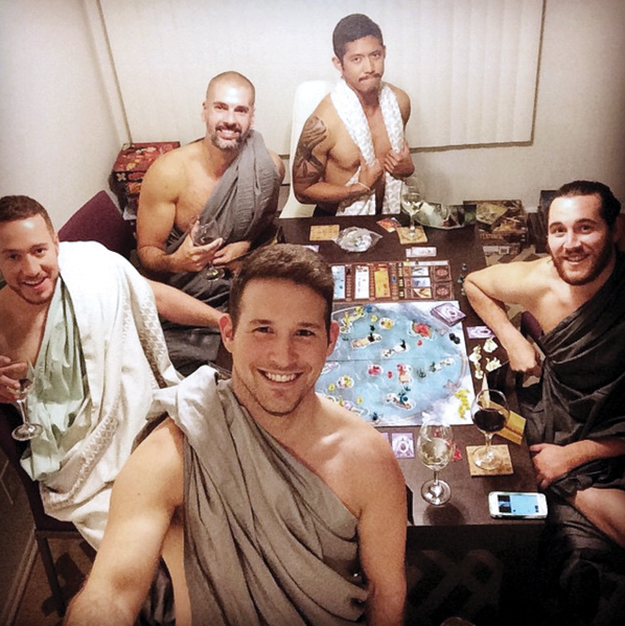
Based on my own experience with boardgaming, I think Brown has a point. Since March, Glen Lakin, a screenwriter (who also happens to be my roommate), has been hosting Dungeons & Dragons sessions in my garage. It’s nothing my grandmother would have envisioned when she willed me her old bridge tables, but it’s been a lesson on how gaming—and gayming—can provide a valuable outlet for those straddling two different subcultures.
The group of seven members—all gay, all male, all of whom work in some creative field—has been following one story, masterminded by Lakin and incorporating bits of classic TV into the swords -and-sorcery setting. (Dwarves named after the girls from The Facts of Life, for example, and a magical lantern called Judith’s Light, revered by the Church of Angela. Yes, he has plans for The Golden Girls.)
Lakin created the group as a social outlet—to scratch an itch created by not dating and not going to bars. And he agrees that many outside the group would be surprised by how an explicitly gay group is often not all that sexual. “Sure, no one is shocked when two players hookup, and it’s not unusual for someone’s boyfriend to get recruited into the group,” he says, “but the games are usually so involved that we forget to take our shirts off or whatever people might imagine when they picture a bunch of gays sitting around a table getting drunk.”
That said, playing these games still carries a stigma with certain people—gay and otherwise—who harbor strict ideas about what constitutes an acceptable way to enjoy leisure time.
“Dungeons & Dragons especially draws a lot of eye rolls,” Lakin says. “Enough people have played Settlers of Catan to ‘get’ board games, but mention D&D and most still ask, ‘Do you dress up?’ No, we don’t dress up. It’s also been a boner-killer more than once when I bring it up at a bar or party. I think people expect me to put on elf ears as soon as the clothes come off.”
The greatest benefit to playing these games, it seems, may be finding the people who do get it—or who at least are willing to learn. Locke Webster, a member of Lakin’s D&D group, describes a simple beauty in the process of group gaming.
“The fun for me in these game systems is seeing all the possibilities—watching how interlocking pieces of chance and player choice weave together to create a good or bad game system,” Webster says. “And you become a group, probably out of necessity, because it’s almost impossible to play a game if all you are doing is teaching it to other people over and over again. You don’t play a game until you clean up the pieces and start the second round of it.”
Webster says D&D necessitates an especially close bond.
“You’re bringing a character to the table that you created and that to some extent you’re expected to play as,” he says. “The easiest way to do that is to be with a group of people you feel comfortable not being yourself with. There’s a lot of figurative (and imagined) going out on limbs, with the hope that the rest of your party is there to catch you.”
Go to gaymers.meetup.com to locate gaymer groups around the world
Continue to page 2 for A Geeky Glossary >>