
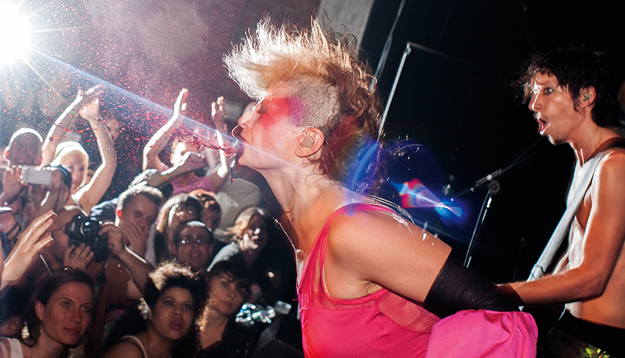
It’s been 15 years since Merrill Nisker exploded into the public consciousness using the nom de plume Peaches. Imploring us to “fuck the pain away,” music—electroclash or otherwise—hasn’t quite been the same since.
Peaches’ signature blend of electronic beats and suggestive lyrics has since propelled her from the rank of mere mortal into a transgressive symbol of shattering gender roles and promoting sex-positivity, while her forays into world-touring stage shows like Peaches Christ Superstar—a one-woman show in which she performed every role of the Andrew Lloyd Webber rock opera—have proven she’s a beast in the realm of highbrow performance art as well.
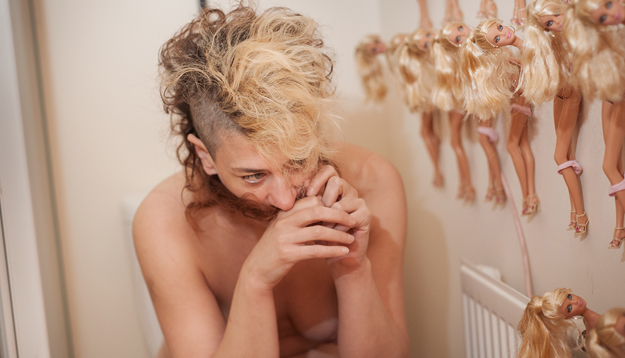
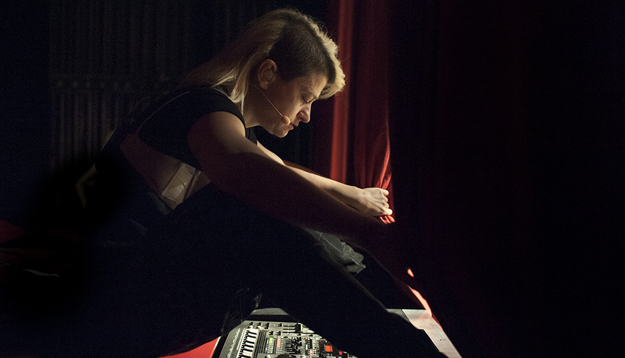
The outrageous and provocative new book What Else is In the Teaches of Peaches (160 pp., $28, Akashic Books), available June 2, presents her as more than the onstage provocateur most know her to be; instead we see her at home with family, rehearsing, sprawled out backstage, exhausted from giving her fans the musical lunacy they crave.
I recently spoke with Peaches from her hotel room in Sydney, after which I understood fully what Yoko Ono meant in the essay she’d written for the book: “She sat quietly but her body was expressing a universe.”
FRONTIERS: How’s Australia?
PEACHES: Insane.
F: Yeah? How so?
P: Oh, it’s just mad. It’s club shows and festival shows and insanity.
F: Tell me about the new book.
P: What I like about the book is that it shows both a private part of me and the public part of me and bridges the two. My shows are so fantastical and also reality-based, but you never see me just hanging out with my parents or looking really tired or doing normal shit. So I like that it’s got both of those together.
F: Was there anything specific that brought on the idea to do the book?
P: Actually there was like this skateboard kid in Berlin who is also a photographer [Holger Talinski] who just asked to take photos of a show and document it, and I was like, yeah, come along, let’s see. He was just a really good human being and very kind, and he took great pictures but also got out of the way and helped. He’s like, “Hey, if you’re ever doing something different, like hanging out with friends or your family or you’re doing public speaking or smoking a joint—whatever—can I come along? Just call me. I’ll be there.” Eventually I asked him to come on tour and it just started to grow from there.
F: Like you said, the book shows real insight into you as an artist but also as a person. Were you at all reticent to open up this much?
P: No, I wasn’t. Holger, the photographer, wanted pictures of me sleeping or in a corner, crying or whatever—all this shit. It took us, I would say, a year of laying photos out and me saying no, no, no, we have to do both—we have to have onstage shots and off-stage shots. And then for him to have my vision of how I want to be presented and his own vision of what he thinks are good photographs, we had so many discussions. I think the book succeeds because we worked so closely together. After a tour or a major session, he would always send me everything and be like, “Which ones do you like?” I’d be like, these ones, and he’s like, “Oh my God, I like these ones, the opposite,” you know?
We’d work through it, and we started to understand. We learned a lot about what he sees in a photograph, and he learned a lot about how I see myself. Then at the end he came to L.A. for shots with my brother, shots with certain people who I really wanted, like Annie Sprinkle—she is probably the only person in the book that I actually actively sought out to be in the book, because she is such a huge influence on me that we actually went to San Francisco.
F: I love hearing that the book was such a collaborative effort.
P: Yes, it definitely is.
F: One of my favorite parts of the book is the story Ellen Page shares.
P: It’s so good, isn’t it?
F: It’s amazing. She talks about how as a young gay person, you offered her something that she couldn’t find elsewhere. First of all, what a fucking compliment—that’s kind of a big deal. You have this reputation of being super sex-positive and breaking the barriers of gender and sexuality, but how much of that was a conscious decision in the beginning versus now?
P: The thing is, I just was talking very directly about what I think the world should look like, and I will continue to do that. That’s all I’ve ever done. I actually didn’t try to be controversial; I just was like, why is this not here and why is this not part of…? This is my world, like, why isn’t this part of it? Why is that missing? Why do we call mainstream this hetero-normative, patriarchal world where actually it’s not? So that’s all.
F: I know you’re going to be in L.A. on May 16. What do you have in store for the book release party?
P: I don’t know. [Laughs]
F: Hey, sometimes that’s just the answer; I completely respect that.
P: I mean, if you find out, let me know. I love Wacko—they’re a really cool store, and I’m happy they’re having me. Also Holger will be showing some of the photographs blown up and stuff, and he’ll be there, too. I think we’re just gonna have fun and drink and laugh a lot.
If people want their book signed, my favorite thing to do is I want them to go through the book and pick their favorite picture so then I can sign on the picture, maybe tell them a little story, go a little more in depth about that picture. That makes it more personal between me and them.