
“Those who cannot remember the past are condemned to repeat it,” said gay philosopher George Santayana—a cautionary lesson often associated with the Nazi Holocaust. Could it happen again? Some think it did during the height of the AIDS crisis when gay men were dying daily with a marked governmental and societal indifference. But in truth, nothing compares to the Holocaust. The profound European and US shrug that greeted Adolf Hitler when he came to power in 1933 resulted in the murder of an estimated 6 million Jews by the end of World War II in 1945. The mass murder was part of Hitler’s Final Solution, along with an estimated 4 million to 6 million non-Jews—gays, gypsies, communists, the disabled and others—who were also killed to “purify” the Aryan race.
Historian Richard Plant concluded that SS Commander Heinrich Himmler, who said in 1937 that the already-outlawed gays led an “abnormal existence,” would “come to believe that the Final Solution was as inevitable for gays as for Jews.”
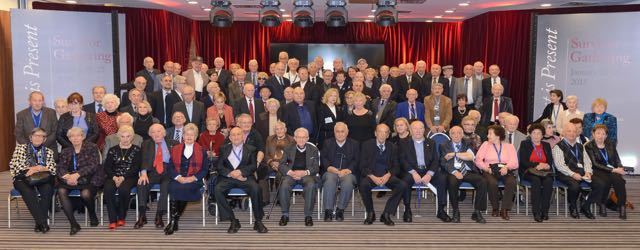
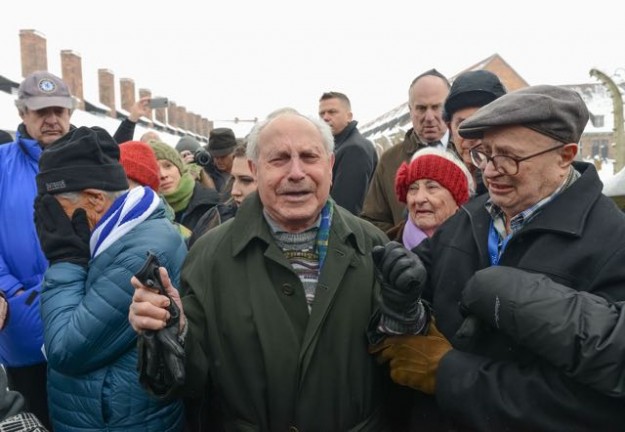
Monday marks the 70th anniversary of the liberation of the Nazi death camps. But aged survivors are dying and with them, their stories of how pure evil succeeded in a world that preferred ignorance to awareness. The World Jewish Congress and the USC Shoah Foundation, founded by director Steven Spielberg after he made his film Schindler’s List, are determined not to let the world forget or history diminish the Holocaust. To mark International Holocaust Remembrance Day on Jan. 27, they brought 100 Auschwitz survivors from 19 countries back to Krakow, Poland to commemorate the anniversary and to note that “the past is present,” especially in light of the recent shootings at Charlie Hebdo and the kosher grocery store in Paris and the rise of anti-Semitism in Europe. (Photo above at the entrance of Auschwitz and from the reception were shot by Shahar Azran. From left to right in the very center in the back group shot above is Ronald S. Lauder, president of the World Jewish Congress; David Zaslav, president and CEO of Discovery Communications; and film director Steven Spielberg, founding chair of the USC Shoah Foundation, surrounded by 100 Auschwitz survivors.)
“[The Holocaust survivors] testimonies give each survivor everlasting life and give all of us everlasting value,” Spielberg said at a reception Sunday. “We need to be preserving places like Auschwitz so people can see for themselves how evil ideologies can become tangible acts of murder. My hope for [Monday’s] commemoration is that the survivors will feel confident that we are renewing their call to remember. We will make sure the lessons of the past remain with us in the present so that we can now and forever find humanitarian ways to fight the inhumanity.”
“I believe that you don’t just represent survivors,” Lauder told the 100 Auschwitz survivors. “All of you here tonight represent one the greatest forces of light over darkness. And for that we are not just grateful, we are in awe of you. You inspire us all.”
1 2