
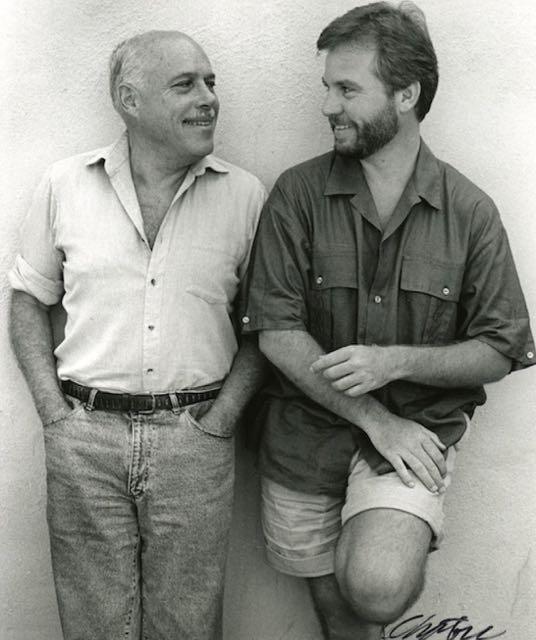
“Malcolm and I met and began this relationship this month, February, in 1984,” Thompson said Friday, adding that Malcolm was then 62, the age Thompson is now. “I have an ever-new appreciation for who he is.” Thompson asked himself what he was doing—falling for an Episcopal priest 30 years his senior! “But once I looked into those incredible eyes, I was gone,” Thompson said, sitting in the lobby of Good Samaritan Hospital.
“We’ve been committed partners for 31 years. We got legally married in our living room with just a few friends and somebody from City Hall once Prop. 8 was resolved in July 2013. But, of course, there was our famous community blessing in 2004 that made the front page of the Los Angeles Times with the church, Bishop Bruno and Malcolm deciding to make that stand” for marriage equality, the same year President George W. Bush advocated in his State of the Union address for a federal marriage amendment to prohibit giving same-sex couples the constitutional right to marry.
“It was a very courageous act on everybody’s part,” said Thompson.
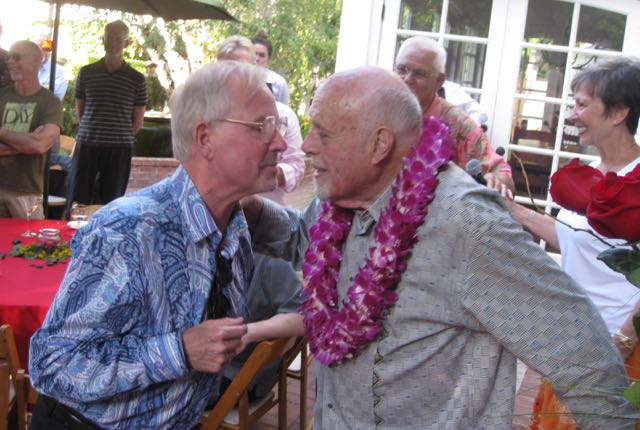
“Malcolm and I were together for over three decades. We had no secrets. But because of the times and places from which we came, it was sometimes difficult. We had to work extra hard to resolve our differences. But always there was love and reaching for a higher ground,” Thompson said. “The last years of our lives have been sublimely perfect. Even I am amazed at his breadth and commitment on so many levels of humanity.”
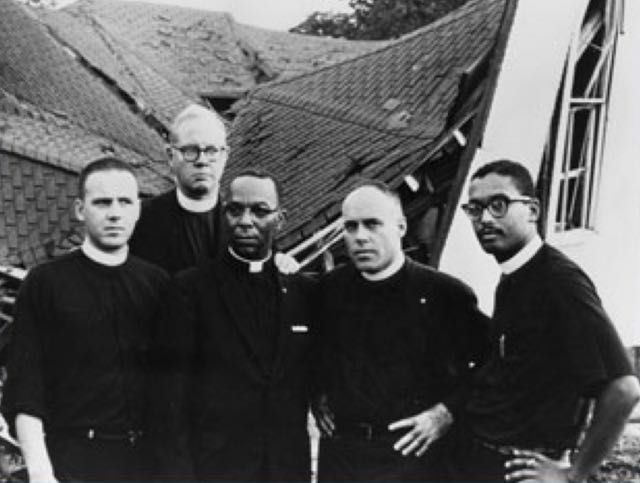
Interestingly, Boyd’s death comes just as the movie Selma is bringing so much attention to the struggles of the early civil rights movement. Boyd was part of that movement in the early 1960s—not just as a white Freedom Rider who headed into the Deep South for an action—but as someone who, for four or five years, would stay for several months and repeatedly return after leaving to help with voter registration. He’s pictured above with other civil rights workers in the early ’60s in front of a bombed black church in McComb, Mississippi.
Boyd “gradually” got involved in the civil rights movement in 1961. “At the outset I simply cared deeply but didn’t know very much about it. It became clear that it was one thing to be legitimately in favor of racial justice, yet quite another to take a controversial public stand on the issue,” he wrote in a June 23, 2014, column for the Huffington Post. Boyd’s life changed when he found himself crying as he read James Baldwin’s Notes of a Native Son and Nobody Knows My Name riding the bus in San Francisco. “I was deeply touched beyond my own defenses. This mattered to me in ways I could not easily understand.”
Deeply influenced by the worker priests in France, the idealistic Boyd realized the church “was not ‘a job’ for me; it was a vocation, a calling by God.” Boyd struggled with whether or not to speak out, afraid to draw “sinful” attention to himself, especially as someone who overwhelmingly felt like an introvert. He explains:
This was personal stuff, but that’s precisely why it was significant. For example, how could I possibly metamorphose into some kind of media personality that would retain even the slightest element of truth? Shouldn’t my goal of priestly servanthood include not drawing attention to myself (as I would be doing in any public role), a contradictory kind of public witness?
To complicate the issue, we were moving into an entirely new era of clerical stardom in the media. Billy Graham was a superstar. So was Norman Vincent Peale. So was Bishop Sheen. Even the Oscars came aboard when Bing Crosby and Ingrid Bergman received Academy Awards for playing clerical roles.
Everything changed for me when I was invited by Louisiana State University to be a speaker for its Religious Emphasis Week. Soon I was invited for a sequel appearance there. Then, suddenly, I was cancelled, period. I was too frank, too outspoken. The issue was race, as the New York Times pointed out in an article. The Times quoted me: “When one becomes involved in such a situation, one must make a choice either to condone evil or to stand up and fight for truth.”
I was caught in my own public situation. I was ready to respond when, in 1961, a letter arrived on my doorstep. It invited me to join a Freedom Ride that would shortly originate in New Orleans and proceed to Detroit. A group of Episcopal priests, black and white, from various parts of the U.S. would participate. Would I like to join them?
I sat all night in a dark room. I prayed. I wrestled with God. And at last I said “yes.”
Our Freedom Ride attracted international attention. Many of our lives were irrevocably changed, mine included. This began a lifetime of involvement and active participation in civil rights.
In 1967, the London Evening Standard wrote, “Boyd is a full time disturber of the peace, a jarring blend of Luther and Lenny Bruce, who is attempting to shock religion into being relevant, to get back to what he calls ‘armpit theology.’”