
Anyone who has listened to longtime gay politico David Mixner share his commitment to Ghandi and Rev. Dr. Martin Luther King Jr., rail against the Vietnam War or anti-LGBT religious right crusaders, or get a catch in his voice talking about his closeted political life or the pain of the AIDS crisis knows that in the deepest recesses of his heart, Mixner is a storyteller. Now, in yet another stage of his fascinating life, Mixner has turned storytelling into his new profession as an author, screenwriter and, most recently, the star of his own one-man play, Oh Hell No!—a vibrant account of historical moments he’s experienced—which will see its L.A. premiere on June 11 as a fundraiser for Point Foundation.
Mixner now lives in Hell’s Kitchen in New York City, but for many years—including from 1976 to 1996, the years he focuses on in the play—Mixner lived in Los Angeles and West Hollywood. The stories he tells are the stories of LGBT L.A. and the nobility and courage of the LGBT community under fire, even as death and dying assumed an absurd everyday normality.
A prominent Democratic strategist, Mixner managed L.A. Mayor Tom Bradley’s 1976 re-election campaign and worked his way through a difficult coming out process with the help of his friends in MECLA, the Municipal Elections Committee of Los Angeles, the nation’s first gay political action committee. He served as the state campaign chair for the successful “No on 6” campaign to stop the anti-gay Briggs Initiative and helped convince Gov. Ronald Reagan to come out against the measure. And when the AIDS crisis hit and the government turned its back on people with HIV/AIDS in the early mid-1980s, Mixner helped his friends and colleagues live to the best of their ability and die with dignity—a process that was an automatic act of love at the time but still reverberates with post-traumatic stress today.
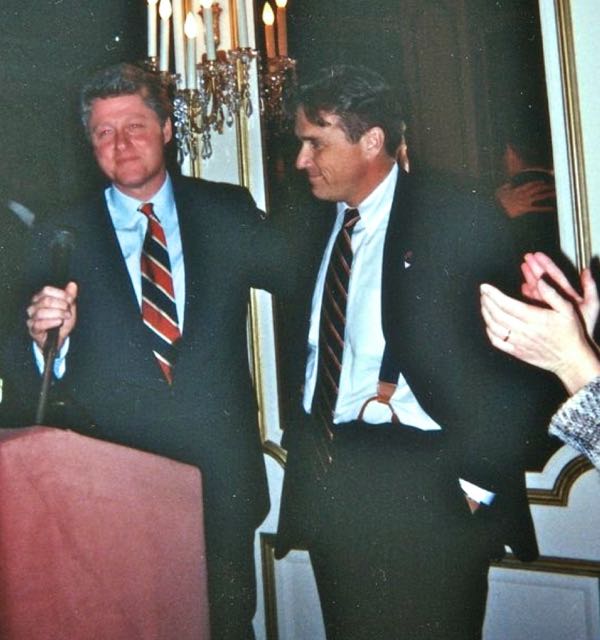
When his friend from the Vietnam War Moratorium days, Arkansas Gov. Bill Clinton, decided to run for president, Mixner invited the Clintons to address MECLA’s successor ANGLE, Access Now for Gay and Lesbian Equality, at Dr. Scott Hitt’s house in the Hollywood Hills in October 1991. After the meeting, Mixner and ANGLE raised $3.1 million in early money and made sure they played a role in the campaign. The day after the endorsement interview, Clinton told reporters that if he was governor of California, he would have signed AB 101, the gay rights bill that Gov. Pete Wilson vetoed. One stipulation for ANGLE’s endorsement was that Clinton speak about AIDS at a major public venue—which he did, saying to an audience that included members of ACT UP/L.A., “I have a vision, and you’re a part of it.” The power-friendship soured, however, after Clinton was elected and signed the military ban compromise “Don’t Ask, Don’t Tell,” over which Mixner and others were arrested at a White House protest.
Mixner says he feels a kind of moral imperative to tell these stories to the next generation. “A year and a half ago, I was in critical condition. I’ve had a bad spell of health issues—11 surgeries and seven stays in intensive care,” Mixner says in a long phone interview with Frontiers. “But the last one a year ago February was particularly tough. And they didn’t think I was going to make it. And when I did pull through—and I have been well ever since—I realized that there were many stories that I had not passed on to the next generation.
“So I decided that I would put it in sort of a Garrison Keillor/Will Rogers format with some music and do a show as a benefit for Point Foundation in New York City,” Mixner continues. “It sold out in about three days and raised nearly $200,000 for Point for just one night in a small theater [last October]. And it got a lot of fantastic reviews. So that was a great incentive to pass these stories along.”
Mixner emphasizes that his stories are 40 years old. “This is my journey, my story to the best of my ability that I can recollect it. Some people will have different interpretations, some will have different memories, some will believe that they were there and they weren’t,” Mixner says. “We are in danger of losing a lot of our history. And we have to remember that this generation that I come out of—a lot of people who could have been the storytellers of our generation—have passed away with AIDS.”
Mixner says he’s very proud of his 90-minute show but acknowledges that it leaves a lot out. “It’s not meant to be an all-encompassing definitive history,” he says. “And let’s just face it, history is a series of flawed recollections. And I don’t pretend that my recollections are perfect.”
But Mixner hopes his stories will capture the essence of the time. The award-winning film Milk, for instance, captured the life and times of gay political icon Harvey Milk in such a way as to suggest Milk was primarily responsible for defeating the Briggs Initiative, without really acknowledging the work of MECLA and such people as Diane Abbitt, Ivy Bottini, Rev. Troy Perry and Gail Wilson in Los Angeles.
“I could nitpick about, ‘Oh that wasn’t true, in my perspective.’ But overall, I thought they did a good job of capturing the history of that moment and in the end, challenging young people to see how an individual of courage could make a difference,” he says.
Mixner also notes that defeating the Briggs Initiative put an end to ballot initiative attempts by the religious right until 1986. “But unfortunately, we had to deal with AIDS, and that gave them new ammunition and threw our community for a loop. But for a long time, almost a decade, they didn’t really try very many initiatives.”
AIDS both undid and strengthened the LGBT community. “I did close to 90 eulogies in two years in the 1980s,” Mixner says. “And you don’t really think about it as you go through it. As I used to say, it was Saturday morning memorial and Saturday night disco.”
But now Mixner says he has PTSD after reliving and writing the stories for the show—and finally talking about how he helped his friends die, at their request, including the love of his life, his partner Peter Scott.
“I’ve never talked about it in public until now. There was a small team that even my closest friends didn’t know about,” he says. “Everyone I was involved with in my team is now dead, so I’m not placing anyone else in jeopardy. But I don’t mention names because I could still be brought up on charges,” though he thinks that’s unlikely to happen. “I decided when I had to do this that I had to be rigorously honest to the best of my ability.”
Mixner adds that he is bringing the issue of assisted suicide to the fore because, “Quite honestly, I want the same rights myself when the time comes. And most importantly, in our 30s and our low 40s—people like us were having to make decisions and choices with other people’s lives—with their permission—that no one at that age should be making.”
Which is also why Mixner feels a moral imperative to share such vulnerabilities. “This generation of youth must know of this story and of the sacrifices and the courage—not only simply to pat our generation on the back—but so they know that they come out of something magnificent, something historic, something noble, something exciting. They were not just plopped here on earth and granted marriage! They have an incredible history that should fill them with pride—one of courage and power and dignity. And if I can make them feel that in a performing way, I’m one happy camper.”
Oh Hell No! also features four Broadway performers—Emily Swallow, Rory O’Malley, Chris Bolin and Dave Koz. Mixner says each of the 10 cities on his national tour will highlight different performers. “It is a production. I mean, it’s not me giving a speech. It is a production. It’s a show.” A show that Mixner hopes will end up in the Kennedy Center.
Oh Hell No! will be at the El Rey Theatre in Los Angeles on June 11, starting at 7 p.m. For ticket information, go to pointfoundation.org. Frontiers Media is a sponsor of the event.
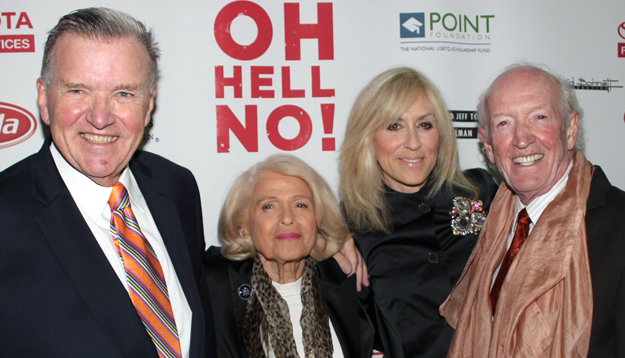
Photo above shows Mixner with DOMA heroine Eddie Windsor and longtime friends, actress/activist Judith Light and friend and Light’s manger Herb Hamsher.