

The day before the one-year anniversary of Brittany Maynard and Compassion & Choices launching a campaign to bring an end-of-life option to California, Gov. Jerry Brown signed the physician-assisted suicide bill—after asking himself what he would do faced with a painful terminal illness and being forced to relocate to another state to die with dignity.
Maynard, a 29 year old newly wed (pictured above), became the “face” of those advocating for death with dignity, even as she was dying. After dealing his severe headaches, she was diagnosed with an aggressive, terminal form of brain cancer in early 2014. She and her family were forced to move from the San Francisco Bay Area to Oregon so Maynard could use that state’s death-with-dignity law.
“Right when I was diagnosed, my husband and I were actively trying for a family, which is heartbreaking for us,” Maynard said in the campaign’s first online video. “That was a major shock to my system and … my family … They just wanted to search for a miracle.”
There was no miracle. Maynard ended her suffering on Nov. 1, 2014.
But Maynard’s courageous participation in the campaign prompted lawmakers— including out Assemblymember Susan Talamantes Eggman and Sen. Mark Leno—to press hard for passage of the End of Life Option Act. Several terminally ill people, including trans Michael Saum, shared their agonizing stories to express the urgent need to help real people.
Since his June interview with Frontiers, Saum, who is also suffering from terminal brain cancer, has moved into hospice care. The bill goes into effect 91 days after the end of the legislature’s special session, which means it may be too late for Saum.
But he anticipated that. “I’m in terrible pain every day, to the point that I’m crying nearly every day. I’ve been told by my doctor that there is no chance for change, no miracle; no treatment is going to heal me. I think I’m going to pass before this bill is enacted,” Saum says, “but if it’s not there for me, I’m grateful I’m able to help others in my situation.”
The debate over the End of Life Option Act was intense and emotional, failing six times before finally being written in such as way as to address most of the concerns expressed by the opposition, including the Catholic Church, which sees suicide as a sin. Brown, a lifelong Catholic and former Jesuit seminarian, had not commented on the bill. His signing statement on Monday, however, was deeply thoughtful:
“ABx2 15 is not an ordinary bill because it deals with life and death. The crux of the matter is whether the State of California should continue to make it a crime for a dying person to end his life, no matter how great his pain or suffering.
“I have carefully read the thoughtful opposition materials presented by a number of doctors, religious leaders and those who champion disability rights. I have considered the theological and religious perspectives that any deliberate shortening of one’s life is sinful.
“I have also read the letters of those who support the bill, including heartfelt pleas from Brittany Maynard’s family and Archbishop Desmond Tutu. In addition, I have discussed this matter with a Catholic Bishop, two of my own doctors and former classmates and friends who take varied, contradictory and nuanced positions.
“In the end, I was left to reflect on what I would want in the face of my own death.
“I do not know what I would do if I were dying in prolonged and excruciating pain. I am certain, however, that it would be a comfort to be able to consider the options afforded by this bill. And I wouldn’t deny that right to others.”
Californians Against Assisted Suicide coalition is not happy and may challenge the law in court or try for a ballot initiative. The coalition said in a statement:
“This is a dark day for California and for the Brown legacy. Governor Brown was clear in his statement that this was based on his personal background. As someone of wealth and access to the world’s best medical care and doctors the Governor’s background is very different than that of millions of Californians living in healthcare poverty without that same access – these are the people and families potentially hurt by giving doctors the power to prescribe lethal overdoses to patients.”
On the other hand, those who worked for passage are relieved and thrilled.
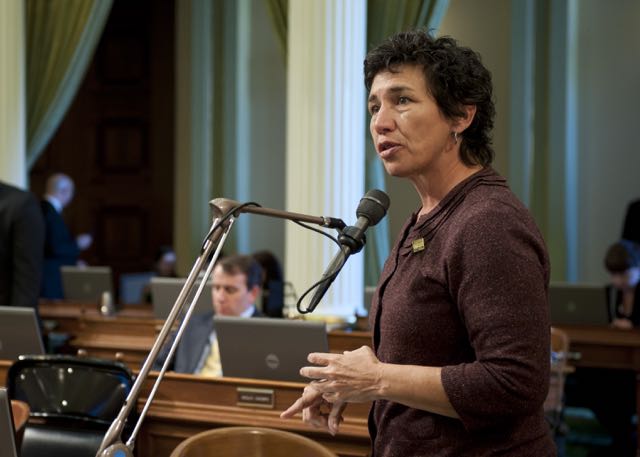
Eggman (pictured above) and Senators Lois Wolk and Bill Monning, who worked on an earlier version of the bill, released the following statement:
“It was Brittany Maynard who provided the impetus to make this moment possible, but there are thousands of people over decades who contributed to this movement. This could not have been achieved without the help of many terminally-ill Californians and their families, who entrusted to us their time and energy, their experiences of suffering and pain, and the sacred value of their hope that we might be able to act in time for them. We are relieved and overjoyed that with Governor Brown’s characteristically reasoned decision, we can say that California has done the best it could to make a difference for them.”
“My hope is that this begins to transform how we look at end of life care in California and across the country,”Eggman added. “It’s a mix of feelings. You know when you work very hard on something, the natural inclination is to feel joy. You don’t have that feeling. I feel, like I said, a sense of relief for people.”
Leno, a co-author of ABX2-15, who recalled how assisted suicide was often discussed during the AIDS crisis in his interview with Frontiers, also issued a statement:.
“California has taken a bold and profoundly important step in offering support and relief to Californians who are needlessly suffering from incurable illnesses. This bill embodies our nation’s basic principles of individual liberty and freedom of choice. That’s just one of the reasons the public overwhelming supports a person’s right to make end of life decisions. It’s the right thing to do, and it’s the compassionate thing to do.”
California now joins Oregon, Washington and Vermont in allowing physician-assisted suicide. Montana does not allow assisted suicide but a 2009 ruling noted that the state’s living will law permits doctor-assisted suicide with a patient’s consent as an acceptable defense if the doctor is charged with murder.
Compassion & Choices noted there are specific differences between the Oregon law and California’s new law—such as a translation requirement for the state where more than 200 languages are spoken—so the group plans on launching an education campaign.
“This means we need to do a significant amount of community education and education of physicians and health providers so that so that everyone is clear on what the act does or doesn’t do and how folks actually can access medical aid in dying if they qualify under the End of Life Option Act,” Toni Broaddus, the group’s California campaign director and former head of the LGBT Equality Federation, told KPCC.