
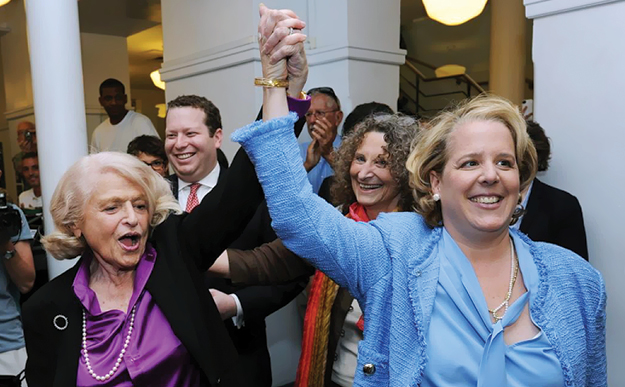
We know how the story ends. It’s a bursting flashbulb on the timeline of LGBT history, though to some it started out as a tiny blip. On Nov. 9, 2010, brilliant Paul, Weiss attorney Roberta Kaplan filed a federal lawsuit on behalf of suave elderly client Edie Windsor seeking a refund of the $363,053 Windsor was forced to pay in estate taxes after the death of her legal spouse, Thea Spyer. Windsor had been denied the usual federal tax exemption for surviving spouses because of the Defense of Marriage Act, DOMA.
By the time the case reached the United States Supreme Court, the world knew about the little old lesbian’s tax case—and more importantly, people grew enamored with the love story of the deeply closeted IBM math whiz and the psychologist, who lived a life together from 1965 to 2009 when Spyer died of MS in the comfortable Greenwich Village apartment the couple shared. On June 26, 2013, the Supreme Court ruled 5 to 4 that Section 3 of DOMA was unconstitutional. Kaplan and Windsor had pulled the rug out from under harmful “traditional” arguments against same-sex marriage, and within two years, marriage equality was the law of the land.
But there is so much more to this gripping historic story. In Then Comes Marriage: United States v. Windsor and the Defeat of DOMA (336 pp., $28, W. W. Norton & Co.), Kaplan and Lisa Dickey reveal scores of behind-the-scenes struggles, including with LGBT movement leaders over legal strategy. When she first decided to fight for her legal marriage to be recognized, Windsor approached Lambda Legal, an organization to which she and Spyer had contributed. “They had a junior guy who was an attorney,” Windsor told Kaplan, “and he said to me, ‘I’m sorry, Edie. It’s the wrong time for the movement.’”
Kaplan writes that Lambda and the ACLU took the position that GLAD’s Mary Bonauto, winner of the first marriage equality case in Massachusetts in May 2004, was also “moving to fast” in filing her March 2009 challenge to DOMA.
That did not sit well. But, Kaplan writes, she had a law firm supporting her pro bono work and one client with an incredibly moving story. Indeed, Kaplan says, she originally wanted to write about “how we won the case strategically and what happened from step to step.” But soon she realized it was a larger, more encompassing human story.
“We won this case not only by changing the law but we won this case by changing hearts and minds,” Kaplan tells Frontiers in a phone interview. “It’s a book about the personal journey that we’ve been on, both Edie and myself, our own stories, our own coming out stories, our relationship together, our family relationship together. I think that’s the only way to tell this story globally, because that’s how we created this revolution—by changing our own lives personally and by changing the views of Americans and the way that they feel.”
Absolutely astounding are the moments of profound kismet, of the cosmic intersection between the lives of Kaplan and Spyer that invariably led Kaplan to Windsor and created in her the deep personal commitment to defeat DOMA. It was a commitment that soon became rooted in Kaplan’s own family life with her wife Rachel Lavine and their son, Jacob.
Kaplan was 24 in the summer of 1991, a new graduate from Columbia Law School who was just coming out and was “seriously depressed and anxious.” On the last weekend in June, gay Pride weekend in New York City, her parents flew out from Cleveland. Kaplan fumed when her mother kept criticizing the gays, and she finally burst out with her secret.
“My mother did not say a word. She simply walked to the edge of the room and started banging her head against the wall. Bang. Bang. Bang,” Kaplan writes. Her worst fears were realized. “The consequences seemed clear: Being gay meant losing the love and support of your family.”
Her mother’s reaction sent her into a downward spiral. “And then I went to see Thea Spyer.”
Continue to Page 2 >>